


































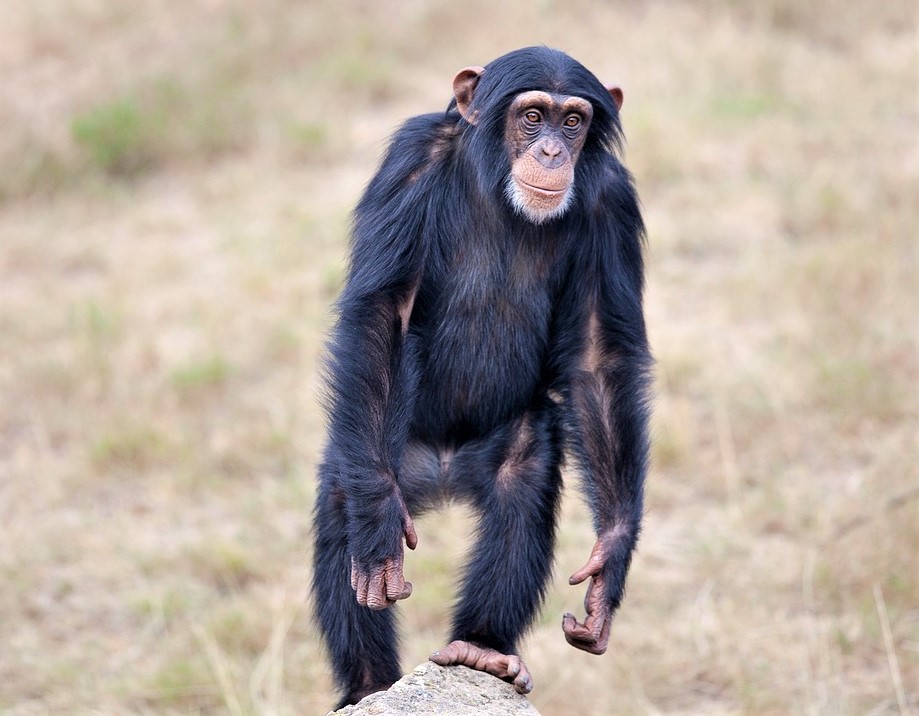
Chimpanzees, our closest relatives in the animal kingdom, possess superhuman strength. Their compact but muscular bodies and powerful movements have captivated scientists and animal lovers. What factors explain their strength advantage over us? What, if anything, can we copy? This is monkey business. Drawing upon scientific research and expert insights, let’s delve into the factors that contribute to the extraordinary strength of chimps.
HOW STRONG ARE CHIMPS COMPARED TO US?
In terms of raw strength, chimpanzees outperform humans by a substantial margin. Studies have shown that an average adult chimp is estimated to be about 50% to 100% stronger than an average adult human male in terms of pulling or lifting force [1]. What makes this even more impressive is that most adult chimps weigh significantly less than we do. Wild adult males weigh between 40 and 70 kg (88 to 154 lbs.) and females weigh between 27 and 50 kg (60 to 110 lbs). Worldwide the average adult human weights 62 kg. (137 lbs.); and, in North America, the average adult weighs 80.7 kg. (178 lbs.).
CHIMP MUSCLE MASS
Chimpanzees possess a remarkable muscle-to-body-mass ratio that exceeds that of humans. Their bodies are adapted for an arboreal lifestyle, where climbing trees, swinging through branches, and performing physically demanding tasks are the norm. The increased muscle mass in their limbs and core enables them to generate immense strength [2].
CHIMP SKELETAL STRUCTURE
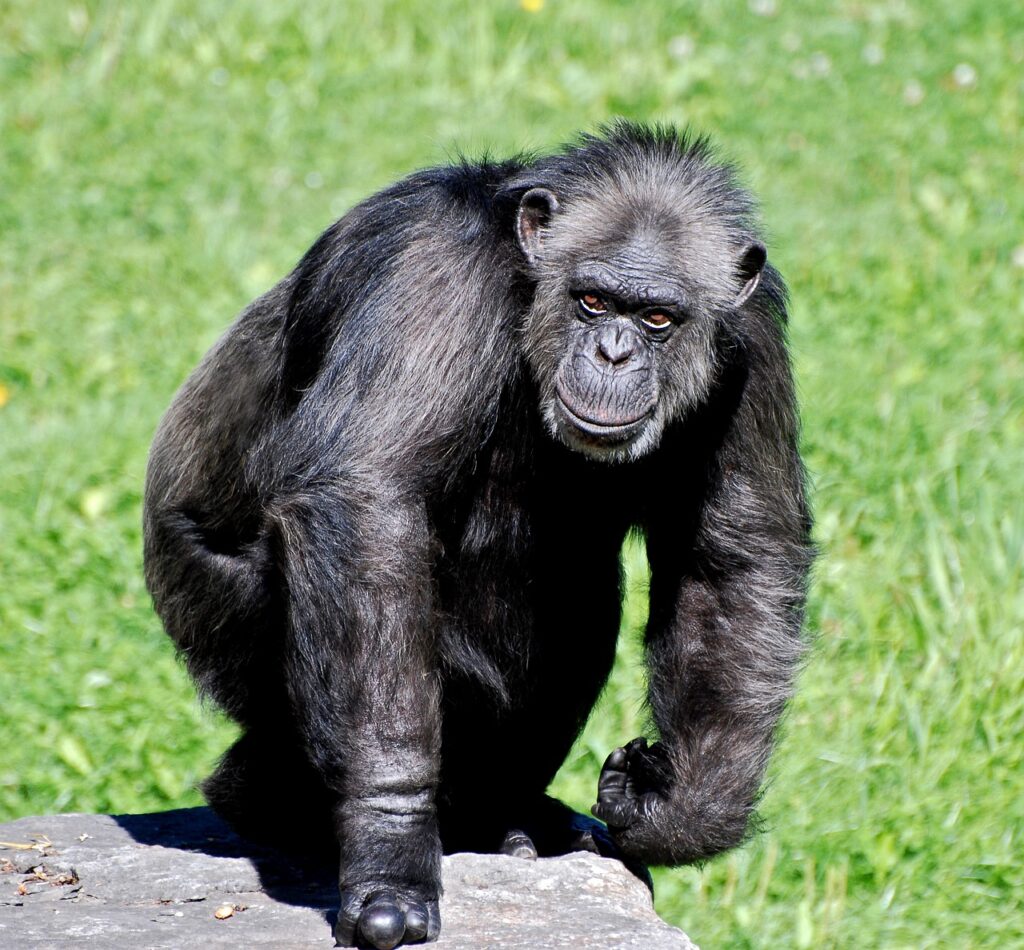
Chimpanzees have robust and dense bones, particularly in their arms and shoulders. These structural adaptations allow them to withstand and generate greater forces during activities such as climbing. The sturdier skeletal framework of chimpanzees contributes to their overall strength [3].
CHIMP MUSCLE FIBER
Research has revealed that chimpanzees possess a higher proportion of fast-twitch muscle fibers compared to humans. Fast-twitch fibers contract more quickly and generate greater force, enabling chimps to exhibit bursts of strength and speed when needed [4]. This muscle fiber composition plays a significant role in their exceptional physical capabilities.
CHIMP NERVOUS SYSTEM
Chimpanzees have a well-developed central nervous system that facilitates efficient coordination of muscle contractions. Their neural control is finely tuned, allowing them to execute powerful movements with precision. This enhanced communication between the brain and muscles contributes to the remarkable strength displayed by chimps [5].
THEY LIVE IN OUTDOOR GYMS.
The natural habitat of chimpanzees—the forested regions of Central and West Africa—presents numerous challenges that demand strength and agility. Navigating complex terrains, climbing trees, and defending themselves against predators require significant physical prowess. Over time, chimps have evolved to meet these demands, resulting in their formidable strength [6].
WHAT ABOUT THEIR VEGAN DIET?
While chimpanzees are primarily herbivorous, with a diet consisting mainly of fruits, leaves, seeds, and other plant material, it’s important to note that their strength cannot be attributed to their vegetarian diet. Chimps have evolved specific anatomical and physiological characteristics that allow them to efficiently process and extract nutrients from plant-based foods. Their digestive systems, including a specialized gut microbiome, are adapted to break down cellulose and extract energy from fibrous plant material. However, the contribution of their diet to their physical strength is indirect rather than a direct cause. Who’s to say they couldn’t be as strong or stronger if they were carnivores?

It’s worth mentioning that humans can also derive substantial strength and muscle development from a well-planned vegetarian or vegan diet. A balanced diet that includes plant-based sources of protein, such as legumes, soy products, nuts, and seeds, can provide the necessary nutrients for muscle growth and strength development in humans. However, direct comparisons between chimpanzee and human strength solely based on dietary differences are challenging because of the multiple interacting factors that contribute to strength.
WHY CHAMPS ARE STRONGER THAN HUMANS: CONCLUSION
Chimpanzees possess incredible strength, which can be attributed to a combination of factors. Their impressive muscle mass, robust skeletal structure, unique muscle fiber composition, well-developed central nervous system, and the demands of their natural habitat all contribute to their exceptional physical abilities. Tarzan aside, these nature and nurture factors cannot be replicated by us. However, understanding the sources of chimp strength provide insights into the evolutionary history of these fascinating creatures and highlight the diversity of adaptations in the animal kingdom.
FURTHER READING
Resources
1. Rilling, J. K., & Insel, T. R. (1999), “The primate neocortex in comparative perspective using magnetic resonance imaging,” Journal of Human Evolution, 37(2), 191-223.
2. Stanford, C. B. (1996), “The social behavior of chimpanzees and bonobos: Empirical evidence and shifting assumptions,” Current Anthropology, 37(5), 747-774.
3. Larson, S. G., & Stern, J. T. (2006), “Forelimb muscle architecture and bone use in common chimpanzees (Pan troglodytes): Long‐term evolutionary implications,” Journal of Human Evolution, 50(5), 563-572.
4. Oishi, H., Takagi, R., & Ohira, T. (2008), “Muscle fiber-type distribution as a predictor of maximum muscle strength in humans,” Journal of Strength and Conditioning Research, 22(3), 1035-1042.
5. Hirasaki, E., Kumakura, H., Nakamura, S., & Izumi, S. (2002), “Functional organization of the corticospinal tract in the chimpanzee,” Comparative Medicine, 52(3), 224-227.
6. Boesch, C. (2008), “Why do chimpanzees die in the forest? The challenges of understanding and controlling for wild ape health,” American Journal of Primatology, 70(8), 722-726.