













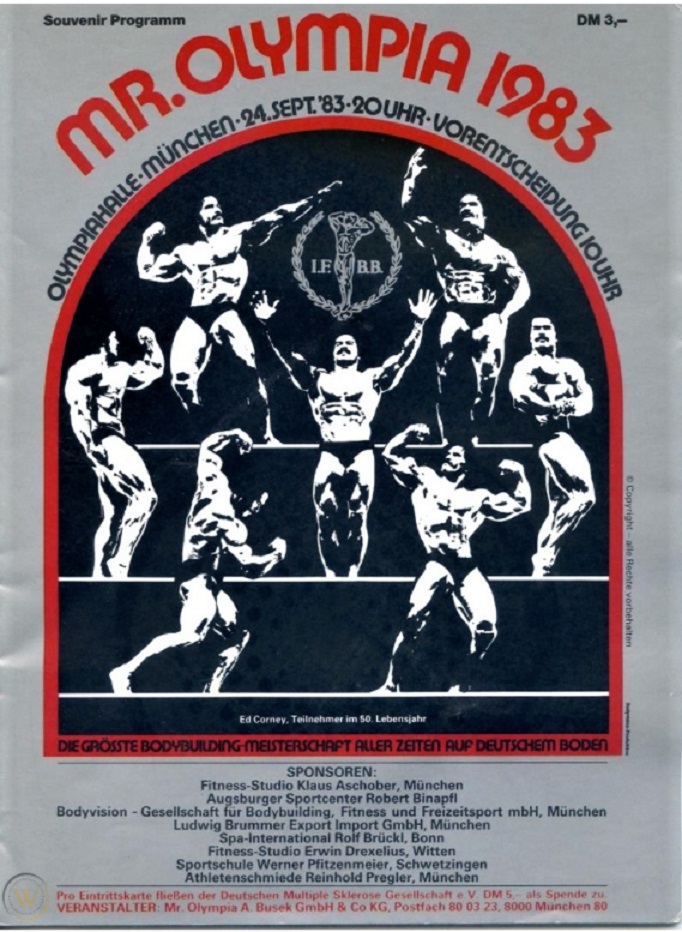
The 1983 Mr. Olympia caught bodybuilding at a crossroads. It was the final year of the “lightweight era,” eight years (1976-83) in which the only Mr. Olympia winner over 200 pounds was a much-lighter-than-usual Arnold Schwarzenegger. The next year the Lee Haney era began. And ’83 was a wide open contest, the rare one with no clear favorite. It was the fifth of six Olympias (1979-84) in which there was a different winner each year—the longest such period in Olympia history. Oh, and it was staged in the most appropriately named Olympia venue of all time: Olympiahalle (built for the 1972 Summer Olympics).
Let’s journey to Munich, Germany, in the Cold War year of compact discs, Michael Jackson’s Thriller, and cocaine-fueled Scarface for the 1983 Mr. Olympia.
1983 MR. OLYMPIA: PRELUDE
Why was the 1983 Mr. Olympia so wide open? Chris Dickerson having finally won the year before after controversial seconds in controversial Olympias the previous two years, decided, at 44, he’d had enough. (Unwisely unretiring the next year, he finished a humbling 11th in the 1984 Mr. Olympia.) Tom Platz had been the popular favorite going into 1982, but a biceps tear derailed his dreams, sinking him to sixth. He decided against competing in Munich, but guest posed instead and received a standing ovation from the appreciative crowd, acknowledging his otherworldly legs and, maybe, if not for the shrunken arm, what could’ve been. (He was ninth in 1984.)
So, who was in Munich then chasing bodybuilding’s ultimate title? The Herculean German Jusup Wilkosz was 10th in the 1982 Mr. Olympia. No one was expecting much from him in his home country. The magical Egyptian Mohamed Makkawy had won a couple pro shows, but he weighed only around a buck-fifty, and he was seventh the year before. The ageless Albert Beckles had also won pro shows. He’d been fifth in the previous Olympia. He’d need to step up his game and come in shredded. Bertil Fox had stirred up a lot of magazine publicity with his chock-a-block thickness, but he was a smooth eighth the year before. A fan favorite, not a judges’ favorite.
Then there was 23-year-old Lee Haney, the rookie phenom with all the potential: mass with class. Haney had already won two pro shows in his maiden professional year. Could the American far from home win the Mr. Olympia on his first try?
Samir Bannout was an intriguing choice. After years of blubbery conditioning, he’d finally nailed it at the 1982 Mr. Olympia and finished an eye-opening fourth. Only one of the three men ahead of him the year before (Frank Zane) was competing this time. But Bannout had never won a pro show. Could the 27-year-old make this, the ultimate pro show, his first pro victory? Seemed unlikely, but maybe…if he could nail it again.
There was only one previous Mr. O in the lineup of 15: three-time (1977-79) champ Frank Zane, who was then 41. The legendary Zane, noted for his classical shape, had been second the year before, so if there was a favorite, he was it. But you wouldn’t have bet on him if you knew about his torn rotator cuff.
1983 MR. OLYMPIA: THE CHALLENGERS
Frank Zane said this about the year 1983 and his final bodybuilding contest:
In May 1983, I was involved in a bicycling accident where I had to slam on my brakes to avoid hitting a car. I flew 10 feet over the handlebars and landed on my right shoulder. I couldn’t raise my right arm for a month, and I had the Mr. Olympia contest to train for in October. My goal was to win the title four times. I trained the best I could, after the shoulder started feeling better, but I couldn’t work my upper body as heavy as before. I couldn’t lock out my right arm. I competed in very muscular condition at a lighter bodyweight of 183 [pounds, at 5’9″] and came in fourth. Already 41 years old, I realized that this was the end of my competitive career, but at least I went out in fantastic condition….After the competition I went to the hospital for diagnosis and they revealed that I had torn a hole the size of a half-dollar in my right rotator cuff; it was hanging on by a thread. Surgery and recovery were traumatic.

The late Jusup Wilkosz at 6′ and 225 pounds was off, both blurry and flat. If he’d been as grainy as he was at the next Olympia, when he was third, he could’ve challenged for a top slot this time, 130 miles from his hometown. Likewise, Albert Beckles had not yet nailed the high-def conditioning that would propel him to second place two years later. The 210-pound Bertil Fox was an enigma. His arms, delts, traps, and chest were the best in the contest, but his back lagged. Though he usually struggled with conditioning, he was on-point this time. The English Fox was a crowd favorite, and the announcement that he was fifth and not higher generated loud and sustained booing from the 4000 spectators. Ultimately, in five Mr. Olympias, this was Fox’s highest placing.

The size difference between the 5’3″, 160-pound Mohamed Makkawy and the 5’11”, 230-pound Lee Haney was a chasm, but it only showed up in side-by-side comparisons. Alone, Makkawy, an Egyptian-born Canadian, cast a spell with his magician-like posing and perfect proportions. Though he was the heaviest guy in the top six, rookie Haney had over-dieted and shed thickness. In the end, giant killer Makkawy slew Haney for second place, a position he would also occupy at the following Olympia, when an even bigger, ever better Haney leapt past him for the win.

1983 MR. OLYMPIA: WINNER
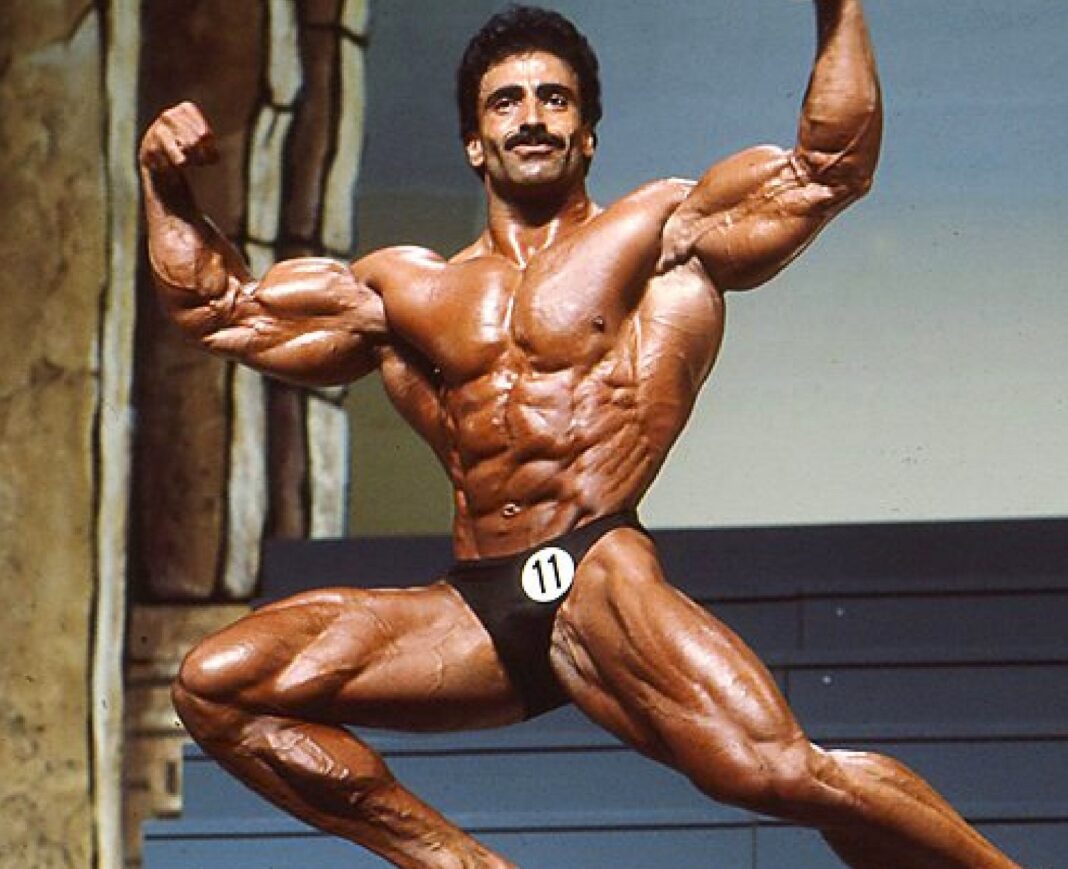
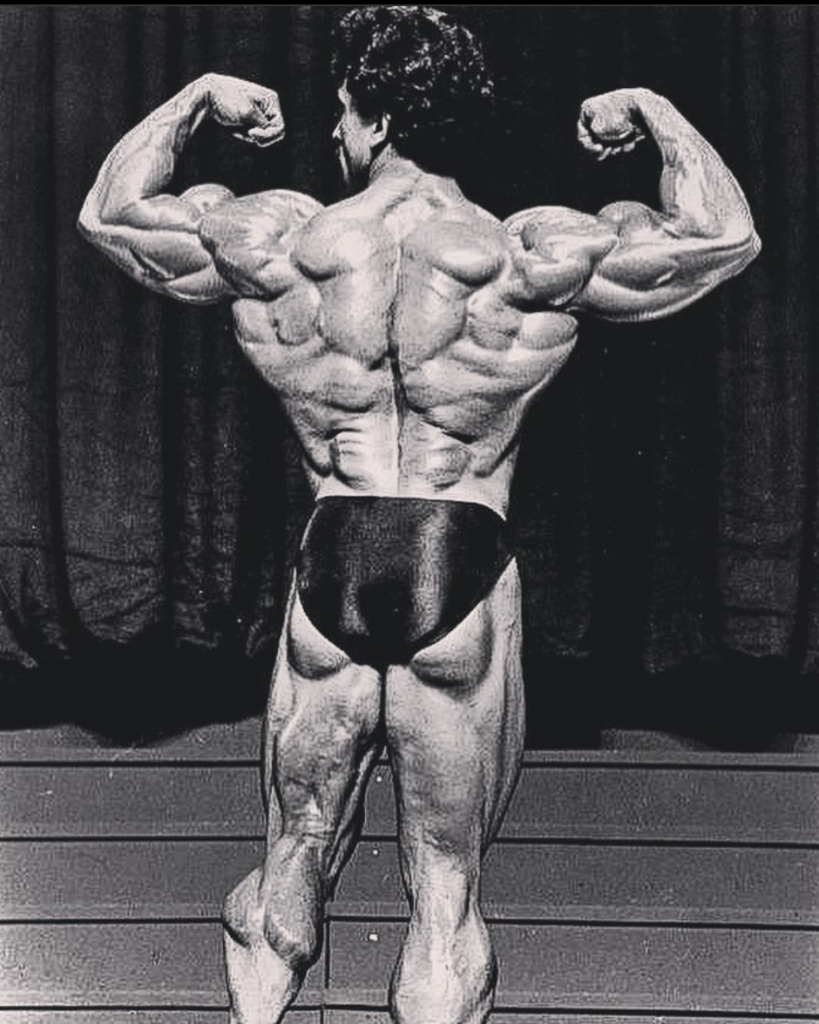
The Lion of Lebanon, Samir Bannout, had immigrated to America from Lebanon in 1974 to pursue bodybuilding. After rapid success as a young amateur, he struggled as a pro in the early 1980s. Water was the problem. Bannout’s 5’7″ body retained too much of it at contests, making him appear smooth despite his superb proportions. He was next-to-last in the 1980 Mr. Olympia and a non-factor again in 1981. But when he mastered the water problem in 1982, lines appeared everywhere, especially in his stellar back, a relief map from glutes to neck.
“It was my dream, I wanted it bad, and I was willing to do whatever it took to make that dream come true,” Samir Bannout said of winning the Mr. Olympia. “There are things we learn as we go. So my body’s chemistry was off for a couple of years because I made a few mistakes. I was overtrying. I was under extreme stress. They say to train to 100; I trained to 300. Knowing what happened to me in ’82, I felt this close, and I really mean it; I felt it could’ve been me on top. We found out why Samir couldn’t get it together. Once I figured it out in ’82, I knew ’83 was going to be me.”

He was right. At only 188 pounds, Bannout’s perfect symmetry made him appear at least 20 pounds bigger. And, forget the water, his conditioning was, if not exactly arid (striated glutes weren’t yet a thing), more than good enough with a pleasing fullness. He was at his best when he faced the curtain; his back won the contest. When you hear the term “Christmas tree” applied to the lines in a striated lower back where the spinal erectors and lower, inner lats meet, it was first said of Samir Bannout at the 1983 Mr. Olympia.
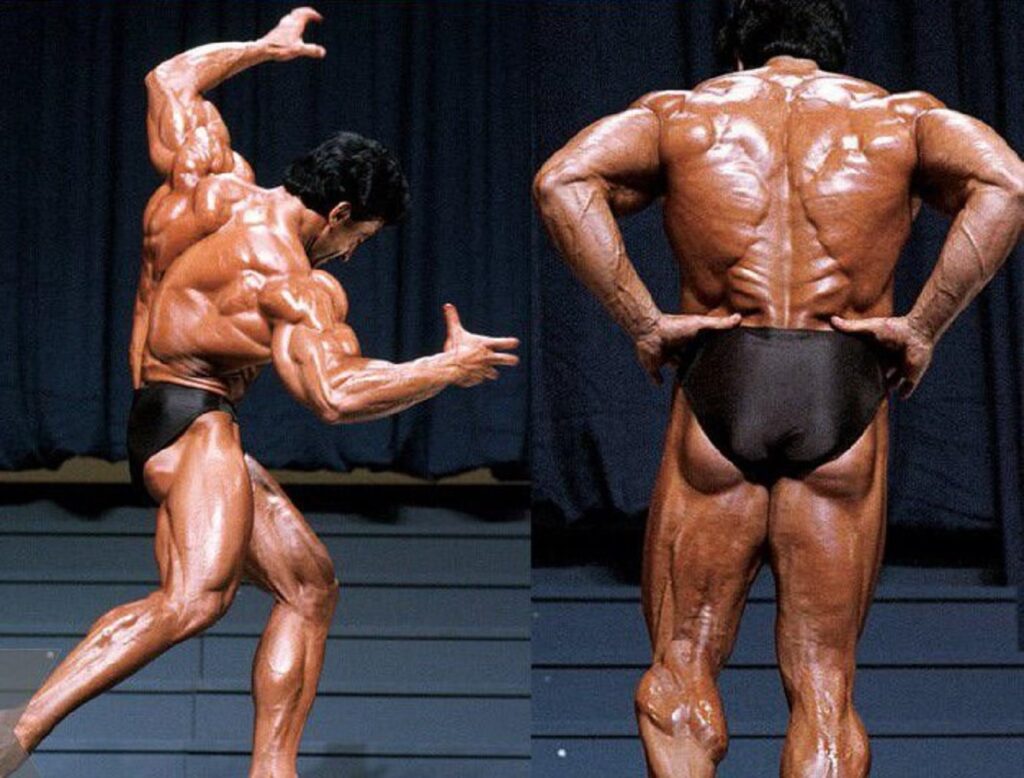
Samir Bannout remains the most classically aesthetic Mr. Olympia champ of all time. Probably not coincidentally, he was also the last winner under 200 pounds. Though he competed in the Mr. Olympia as late as 1994 and in a pro master’s show in 2011, he won only one more IFBB pro show, a minor one, making him sort of pro bodybuilding’s one-hit wonder. Still, many look back at Samir Bannout’s 1983 combination of a pleasing shape, flowing lines, masterful posing, and just the right amount of striations and size as a paradigm of what bodybuilding should be.
1983 MR. OLYMPIA RESULTS
September 24, 1983 / Olympiahalle / Munich, Germany
1. Samir Bannout ($25,000)
2. Mohamed Makkawy ($10,000)
3. Lee Haney ($6000)
4. Frank Zane ($4000)
5. Bertil Fox ($3000)
6. Jusup Wilkosz ($2000)
7. Albert Beckles
8. Johnny Fuller
9. Hubert Metz
10. Jacques Neuville
11. James Gaubert
12. Dale Ruplinger
13. Gerard Buinoud
14. Ed Corney
15. Lance Dreher