





























Front squat vs. back squat may seem like an unfair comparison. After all, you can see back squats done all the time in gyms all over the world. They may be the cornerstone of your leg day, as they are for millions of other weight-trainers. They’re so common, they’re just called squats. There’s no confusion, if you say you’re going to squat, everyone knows the bar will be resting on your upper traps, not your front deltoids.
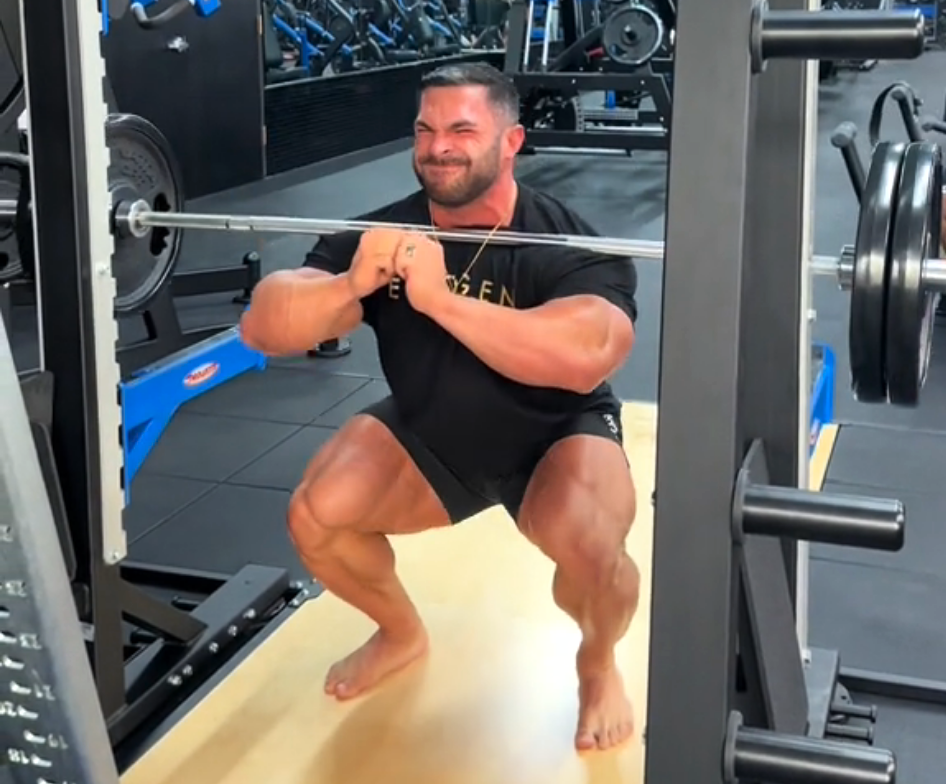
By contrast, front squats are a rarity. Though they were quite common a half a century ago, they were nearly forgotten with the proliferation of leg machines in modern gyms. But they never went away, and they may be making a comeback. The last two Mr. Olympias, Hadi Choopan (seen in the photo below) and Derek Lunsford (seen in the photo above), regularly do front squats and together they sport four of the biggest wheels in bodybuilding history.
Let’s compare and contrast the front squat and the back squat. Understanding their differences can help lifters choose the best variation for their goals and training needs.
FRONT SQUAT VS. BACK SQUAT: MUSCLES ACTIVATED
The back squat is more of an overall lower body exercise, better activating the glutes, lower back, and thigh adductors along with the quads. The front squat is a better quad exercise, and it also activates the upper body and core more to keep you stabilized.
BACK SQUAT
Back squats are performed with the barbell resting on the upper traps or rear deltoids, depending on whether it’s a high-bar or low-bar variation. The mechanics of the back squat emphasize the posterior chain, including the glutes, hamstrings, and lower back. Additionally, the quadriceps are heavily involved, particularly in the ascent phase.
- Quadriceps: Primary movers, especially in the ascent.
- Glutes: Assist in hip extension.
- Lower back: Engaged to maintain a neutral spine and support the barbell.
- Adductors: Assist in stabilizing the legs and hips.
FRONT SQUAT
Front squats require the barbell to be held across the front of the shoulders, demanding a more upright torso. This position shifts the emphasis primarily to the quadriceps while also heavily engaging the core and upper back to maintain balance and posture.
- Quadriceps: Receive greater emphasis due to the upright position.
- Core muscles: Work harder to stabilize the spine.
- Upper back and shoulders: Engage to support the barbell and maintain an upright posture.
FRONT SQUAT VS. BACK SQUAT: TECHNIQUE AND FORM
BACK SQUAT
Proper form in back squats involves setting the barbell on the traps or rear deltoids, depending on the variation. Lifters initiate the movement by pushing the hips back and bending the knees, descending until the thighs are at least parallel to the ground. Maintaining a neutral spine is crucial to prevent injury. There are two variations:
Low-Bar Back Squat: Barbell rests lower on the rear deltoids, torso leans forward more, greater emphasis on the posterior chain.
High-Bar Back Squat: Barbell rests on the traps, torso remains more upright, greater emphasis on quadriceps.
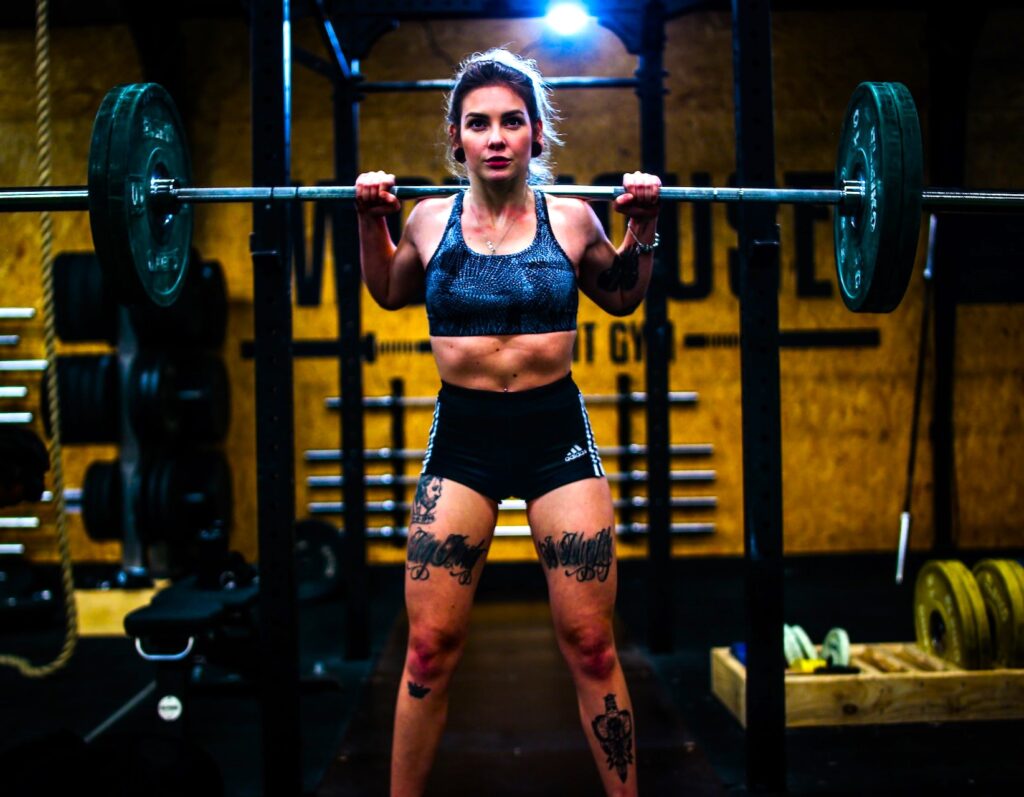
Front Squat
Front squats require the barbell to be placed on the front deltoids and clavicles, which in turn requires more wrist flexibility and upper body strength than a back squat. The lifter must keep their elbows high to prevent the bar from rolling forward. The descent involves pushing the knees forward and maintaining an upright torso, which increases the demand on the quadriceps and core. Different from back squats, the front squat requires more pronounced knee flexion and a more upright torso. The fact that the bar’s placement forces you to stay upright is a plus for those who regularly lean too far forward during back squats. If you can master the front squat, there will be no leaning forward.
FRONT SQUAT VS. BACK SQUAT: BENEFITS OF EACH
BACK SQUAT
- Strength and Muscle Mass Gains: You’re typically 10% to 20% stronger in the back squat than the front squat. The ability to lift heavier loads can lead to greater strength and muscle gains.
- “Squat” Strength: The back squat is the “squat,” a prime indicator of lower body strength. It’s one of the three powerlifts. If you want to be a stronger squatter, you’ll have to squat (i.e. back squat).
- More Comfortable: Many find the front squat an awkward and uncomfortable lift. With practice, this will dissipate, and you can cushion the bar if it digs into your front delts. Nevertheless, the back squat is more comfortable for most weight-trainers.
FRONT SQUAT
- Improved Posture and Core Strength: The upright position improves posture and core stability. And it forces you to keep your torso nearly perpendicular to the floor throughout each rep.
- Leg Strength: Just as the back squat is a better overall lower body exercise, the front squat is a better leg exercise and thus a better barometer of pure leg strength. And while the squat is one of the three powerlifts, the front squat is approximated in Olympic weight-lifting and is typically part of a competitive weight-lifting training program.
- Quad Development and Mobility: Greater emphasis on the quadriceps and increased demand on mobility in the hips, ankles, and thoracic spine.
FRONT SQUAT VS. BACK SQUAT: INJURY CONSIDERATIONS
BACK SQUAT
Back squats carry a risk of lower back strain if the lifter fails to maintain a neutral spine. Proper form and appropriate load management are essential to prevent injury. Avoid excessive forward lean or rounding of the spine. In fact, if either of these are problems, the front squat may be the best choice, because it will force you to stay upright with good posture. Shoulder stress is also a possibility with the back squat. Make certain you have enough mobility to hold a heavy load behind your neck or use a safety squat bar.
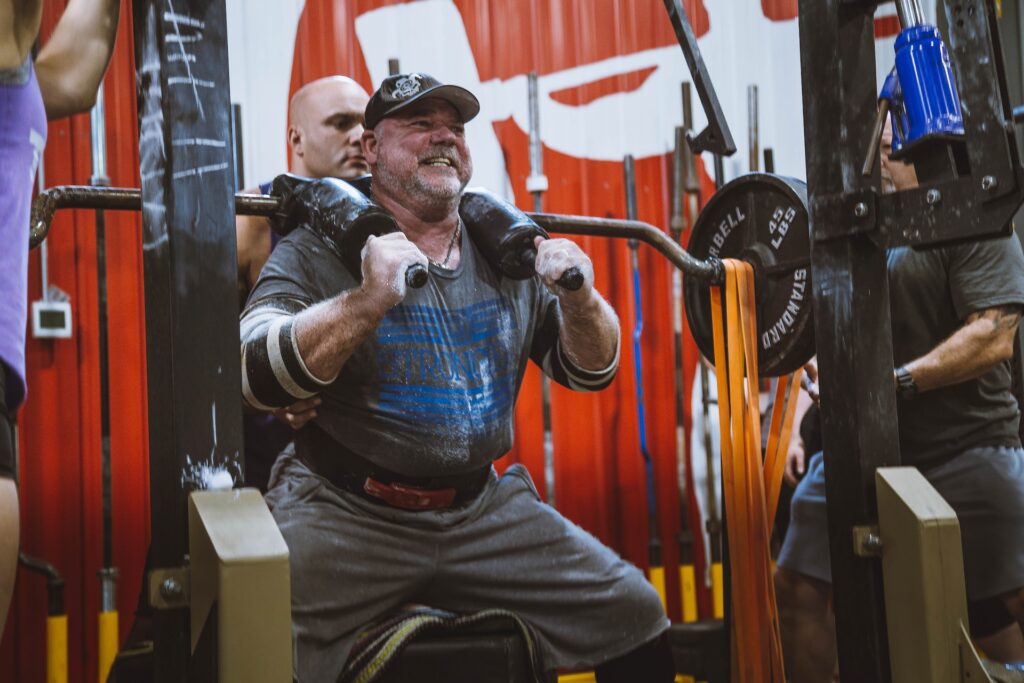
FRONT SQUAT
Front squats pose a lower risk of lower back injury due to the upright torso position. However, the increased load on the knees and wrists requires careful attention to form. Additionally, it may take time to build up a tolerance to holding the bar on your front deltoids and clavicles, especially if you’re capable of using heaving weights. If so, use a pad or rolled towel to cushion the center of the barbell.
FRONT SQUAT VS. BACK SQUAT: CONCLUSION
Both front squats and back squats offer unique benefits and challenges, making them valuable additions to a well-rounded strength training program. Back squats are unparalleled for building overall strength and muscle mass, particularly in the posterior chain. Front squats, on the other hand, emphasize quad development, core stability, and posture. The choice between the two depends on individual goals, training experience, and biomechanical factors. At the very least, we suggest you stop thinking only back squats are squats. Front squats are squats, too, and, by focusing more on the quads and forcing you to stay upright, they may be the right choice for you, at least some of the time.
SOURCES
Contreras, B., & Schoenfeld, B. (2011), “Are All Hip Extension Exercises Created Equal?” Strength and Conditioning Journal, 33(5), 36-39. Link
Gullett, J. C., et al. (2009), “A Biomechanical Comparison of Back and Front Squats in Healthy Trained Individuals,” Journal of Strength and Conditioning Research, 23(1), 284-292. Link
Rippetoe, M., & Kilgore, L. (2007), “Starting Strength: Basic Barbell Training,” The Aasgaard Company.
Kraemer, W. J., & Fleck, S. J. (2005), “Strength Training for Young Athletes,” Human Kinetics.
Escamilla, R. F., et al. (2001), “A Three-Dimensional Biomechanical Analysis of the Squat During Varying Stance Widths,” Medicine and Science in Sports and Exercise, 33(6), 984-998. Link